
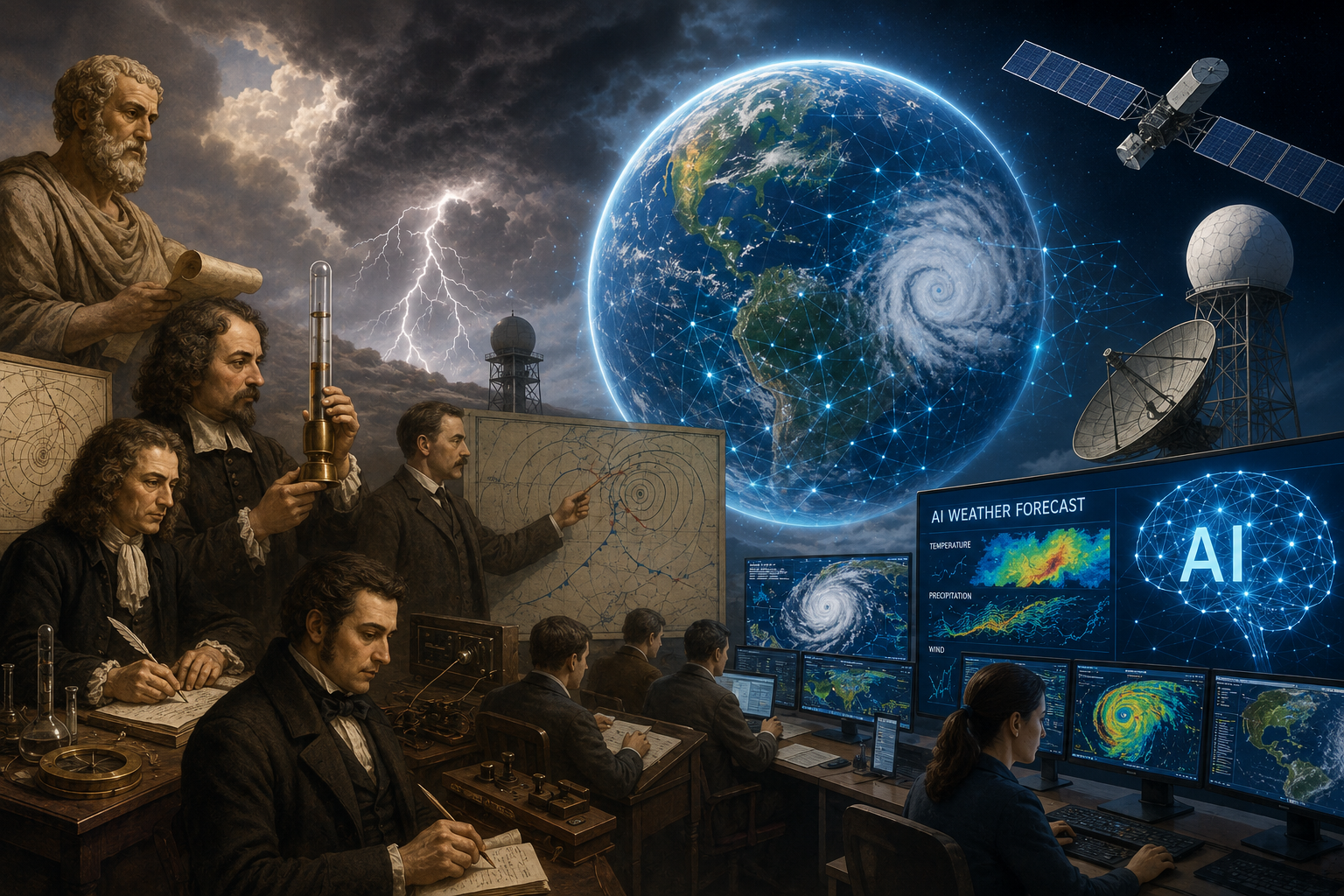
The question of what the weather will do next has haunted humanity for millennia. It is a question as old as the first human settlements, as persistent as the first storms, and as complex as the first attempts to measure the sky. Long before the invention of the barometer, the first weather forecasts were whispered in the voices of farmers and sailors, who read the clouds and the wind to predict the future. By the time the Greeks began to write about the atmosphere, they were already grappling with the same fundamental challenge: how to make sense of a chaotic, transforming force.
This history is not just one of scientific progress, but of human ingenuity in the face of uncertainty. It is a story of observation, calculation, and invention, of how each generation built upon the knowledge of the last to refine its understanding of the natural world. From the philosophical musings of Aristotle to the machine-learning algorithms of the 21st century, the quest to predict the weather has been a continuous thread through the fabric of human civilization. It is a story of how humanity has repeatedly found new ways to observe, measure, calculate, and communicate the atmosphere.
The journey begins in the 4th century BCE, when Aristotle, the philosopher and natural scientist, wrote about the forces that shaped the weather. His observations, though rudimentary by modern standards, laid the groundwork for a systematic approach to meteorology. Over the centuries, this approach evolved through the invention of instruments, the development of mathematical models, and the expansion of global observation networks. Each step forward was not a sudden leap, but a careful accumulation of knowledge, a refinement of methods, and an adaptation to the limitations of the time.
Today, as artificial intelligence reshapes the field of weather prediction, the same question remains: what will the weather do next? The answer lies not in the future, but in the past. The history of weather forecasting is a testament to humanity’s relentless pursuit of understanding, a journey that continues to unfold in the present.
When the Atmosphere Became Measurable
The first attempts to understand the weather were shaped by observation and intuition. Ancient civilizations relied on the movement of clouds, the behavior of animals, and the patterns of the stars to predict the weather.
It was not until the 4th century BCE that the Greeks began to approach the subject with a more systematic and scientific mindset. Aristotle, in his work Meteorology, described the forces that shaped the weather, though his theories were not always accurate by modern standards. He believed that the air was composed of four elements which were earth, water, fire, air and that these elements combined to create different weather conditions. While this framework was later abandoned; it marked the beginning of a more structured approach to meteorology.
Aristotle’s work was not the only contribution to early weather understanding. Theophrastus, his student, expanded on these ideas in his treatise On Weather, which explored the effects of wind, temperature, and humidity on the atmosphere. These early thinkers laid the groundwork for a more systematic study of the weather, but they lacked the tools to measure atmospheric conditions with precision. It was not until the Renaissance that the first instruments for measuring the weather were developed, marking a turning point in the history of meteorology.
The invention of the barometer in the 17th century was a important step in this evolution. Evangelista Torricelli, an Italian physicist and student of Galileo, created the first mercury barometer in 1643. This device allowed for the measurement of atmospheric pressure, a key factor in understanding weather patterns. Torricelli’s barometer was a simple yet radical instrument, and it provided the first quantitative means of tracking changes in the atmosphere. His work demonstrated that the air had weight and that its pressure varied depending on the weather. This was a profound realization, as it suggested that the atmosphere was not a static, unchanging force but a evolving system that could be studied and predicted.
The barometer was soon followed by other instruments that allowed for the measurement of temperature, humidity, and wind speed. These tools enabled meteorologists to collect data on a scale that was previously unimaginable. Over time, these measurements were compiled into weather charts, allowing for the identification of patterns and the prediction of future conditions. The transition from philosophical speculation to empirical measurement was a defining moment in the history of weather forecasting.
As the 17th century gave way to the 18th, the study of the atmosphere expanded beyond mere observation. The work of scientists such as Blaise Pascal and his father, Étienne Pascal, further refined the understanding of atmospheric pressure. Pascal’s experiments demonstrated that atmospheric pressure decreased with altitude, a discovery that would later be vital in the development of weather models. By the late 18th century, the foundations of modern meteorology were being laid, as the first weather maps were created and the first systematic attempts to predict the weather were made.
This era marked the beginning of a new approach to understanding the atmosphere: one that combined observation with measurement, and intuition with science. The tools of the 17th and 18th centuries laid the groundwork for the mathematical and technological advancements that would follow in the centuries to come.
The Forecast Factory
By the 19th century, the study of the atmosphere had evolved beyond simple observation. The invention of the barometer and the development of temperature and wind measurements had provided a means of tracking atmospheric conditions, but it was the emergence of mathematical models that truly transformed the field. The idea that the atmosphere could be treated as a system governed by physical laws was a radical departure from earlier approaches, but it marked the beginning of a new era in weather prediction.
One of the most influential figures in this transformation was Vilhelm Bjerknes, a Norwegian physicist and meteorologist who laid the foundation for modern numerical weather prediction. In 1904, Bjerknes proposed that the atmosphere could be modeled using a set of equations that described the motion of air, the distribution of temperature, and the behavior of pressure systems. His work was pioneering, as it suggested that the weather was not merely a chaotic collection of random events, but a system that could be predicted with the right tools.
Bjerknes’ ideas were not immediately realized, as the mathematical equations he proposed were too complex for the computational tools available at the time. However, they provided a conceptual framework that would guide future developments in the field. The next major breakthrough came in the form of Lewis Fry Richardson, an English mathematician and meteorologist who sought to apply these equations to real-world weather forecasting. In
1922, Richardson published a paper titled Weather Prediction by Numerical Integration, in which he outlined a method for calculating the future state of the atmosphere using a set of mathematical equations.
Richardson’s approach was ambitious, but it was also limited by the computational power available at the time. His method required solving a vast number of equations, a task that was impossible for the rudimentary calculators of the era. Even so, his work demonstrated that the atmosphere could be modeled with mathematical precision, and it laid the groundwork for the development of numerical weather prediction. His calculations, though impractical to perform manually, provided a conceptual blueprint for future advancements.
The limitations of manual computation were soon overcome by the advent of the first electronic computers in the mid-20th century. These machines provided the computational power needed to process the vast amounts of data required for numerical weather prediction. The first computer-based weather forecast was conducted in 1950 by the United States National Weather Service, which used the ENIAC computer to calculate the evolution of a weather system. This was a central moment in the history of meteorology, as it marked the first time that the atmosphere had been modeled using a computer.
The development of numerical weather prediction transformed the field of meteorology, shifting it from a discipline based on observation and experience to one rooted in mathematical modeling and computation. This era, often referred to as the "forecast factory," was characterized by the integration of physics, mathematics, and technology to create more accurate and reliable weather forecasts. The work of Bjerknes, Richardson, and the early pioneers of computer-based forecasting laid the foundation for the modern practice of weather prediction, setting the stage for the next major breakthrough in the field: the recognition that weather was not always
predictable.
Learning That Weather Has Limits
The development of numerical weather prediction in the mid-20th century marked a significant leap forward in the field of meteorology. By the 1960s, the ability to model the atmosphere with increasing accuracy had led to more reliable forecasts, but it also revealed an inconvenient truth: the weather was not always predictable. This realization came to a head in 1961 when Edward Lorenz, an American mathematician and meteorologist, demonstrated that small changes in initial conditions could lead to vastly different outcomes in weather models.
Lorenz’s discovery was born from an experiment in which he attempted to reproduce a weather forecast using a simplified computer model. He had run a simulation for a particular weather scenario and later wanted to re-run it using slightly different initial conditions. To save time, he rounded the numbers to a few decimal places rather than using the full precision of the original data. When he ran the simulation again, the results were dramatically different from the original forecast. This was a striking example of how even the smallest changes in the initial conditions of a system could lead to completely different outcomes.
Lorenz’s findings, which he later described as the "butterfly effect," demonstrated the inherent unpredictability of the atmosphere. The concept was not new, chaotic systems had been studied in mathematics for decades, but Lorenz was the first to apply it to weather prediction. His work showed that the atmosphere was a chaotic system, one in which small uncertainties in the initial conditions could lead to large errors in the forecast. This was a fundamental challenge to the prevailing belief that numerical weather prediction could produce perfect forecasts.
The implications of Lorenz’s discovery were profound. It meant that even with the most advanced models and the most precise data, weather forecasts would always be subject to uncertainty. This realization led to a shift in the approach to weather prediction, from the pursuit of perfect forecasts to the development of probabilistic forecasting methods. Instead of providing deterministic predictions, meteorologists began to focus on the likelihood of different weather outcomes, acknowledging that the atmosphere was inherently unpredictable beyond a certain point.
This shift in perspective was not only theoretical, but it also had practical consequences for weather forecasting. By the 1970s, meteorologists were using ensemble forecasting techniques, which involved running multiple simulations with slightly different initial conditions to account for uncertainty. This approach allowed for more accurate and reliable forecasts, as it provided a range of possible outcomes rather than a single deterministic prediction. The work of Lorenz and other pioneers in chaos theory laid the foundation for modern weather forecasting, which now incorporates a deep understanding of the limitations of prediction.
The recognition that weather was not always predictable marked a turning point in the history of meteorology. It forced the field to confront its limitations and to develop new methods for dealing with uncertainty. This era of discovery and adaptation set the stage for the next major advancement in weather prediction: the expansion of global observation networks and the development of satellite technology.
When the Sky Was No Longer a Mystery
The limitations of traditional weather forecasting became even more apparent as the field expanded beyond local observations to global scale. By the mid-20th century, meteorologists had begun to realize that the atmosphere was a vast, interconnected system that could not be fully understood through ground-based measurements alone. This realization led to the development of satellite technology, which would revolutionize the way weather was
observed and predicted.
The first weather satellite, TIROS-1, was launched by the United States in 1960. This satellite, developed by the National Oceanic and Atmospheric Administration (NOAA), was a small, spherical device equipped with television cameras that could capture images of the Earth’s surface and atmosphere. The images provided a new way to observe weather patterns, allowing meteorologists to track the movement of clouds, monitor the development of storms,
and study the behavior of the jet stream. These observations were far more thorough than those obtained from ground-based instruments, as they provided a global perspective on atmospheric conditions.
The success of TIROS-1 led to the development of a series of weather satellites, each with increasingly advanced capabilities. The Nimbus program, launched in the 1960s, introduced a new generation of satellites that could measure temperature, humidity, and wind speed with greater precision. These satellites also enabled the first real-time monitoring of weather systems, allowing for more accurate and timely forecasts. The ability to observe the atmosphere from space marked a significant milestone in the history of meteorology, as it provided a level of detail and coverage that was previously unimaginable.
As satellite technology continued to evolve, so did the methods of weather prediction. The data collected by these satellites was integrated into numerical weather prediction models, allowing for more accurate simulations of atmospheric conditions. The development of geostationary satellites, which remained fixed over a particular point on the Earth’s surface, enabled continuous monitoring of weather systems, making it possible to track the development of hurricanes, typhoons, and other severe weather events in real time. This capability was particularly valuable for forecasting extreme weather, as it allowed meteorologists to issue early warnings and provide
more precise guidance to those in affected areas.
The expansion of satellite technology also had a profound impact on the field of meteorology beyond weather prediction. It enabled the study of climate patterns, the monitoring of environmental changes, and the tracking of air pollution and ocean currents. These applications demonstrated that the same tools used to predict the weather could be applied to a wide range of scientific and environmental challenges. The integration of satellite data
into weather forecasting models continued to refine the accuracy of predictions, making it possible to forecast weather with greater confidence and reliability.
By the late 20th century, the field of meteorology had evolved into a discipline that combined physics, mathematics, and technology to understand and predict the atmosphere. The development of satellite technology had played a key role in this transformation, providing the data needed to build more sophisticated models and improve the accuracy of forecasts. This era of technological advancement laid the foundation for the next great leap in
weather prediction: the integration of artificial intelligence and machine learning into the forecasting process.
When Machines Learn the Sky
The integration of artificial intelligence and machine learning into weather forecasting has marked a new era in the history of meteorology. As computational power has grown exponentially, meteorologists have begun to explore new ways to analyze vast amounts of atmospheric data, identify patterns, and improve the accuracy of forecasts. Machine learning algorithms, which can process and learn from large datasets, have become an essential
tool in this transformation.
One of the earliest applications of machine learning in weather forecasting was the development of ensemble forecasting techniques, which had been used since the 1970s to account for uncertainty in weather models. However, the advent of powerful data-processing systems in the late 20th century allowed for the refinement of these techniques, making them more efficient and accurate. By the 21st century, machine learning had become a key component in the development of numerical weather prediction models, enabling meteorologists to simulate complex atmospheric processes with greater precision.
The use of artificial intelligence in weather forecasting has also led to the development of new types of models that can analyze data in ways that traditional models could not. For example, deep learning algorithms have been used to process satellite imagery, identifying patterns in cloud formations, storm systems, and other atmospheric phenomena. These algorithms can detect subtle changes in weather patterns that might be missed by human
analysts, providing more accurate and timely forecasts.
One of the most significant breakthroughs in this area has been the development of machine learning models that can predict extreme weather events with greater accuracy. Traditional weather models often struggle to predict the exact timing and location of severe storms, hurricanes, and other extreme weather phenomena. However, machine learning algorithms have shown promise in improving the accuracy of these predictions by identifying complex
relationships between atmospheric variables that are difficult to model using traditional physics-based approaches.
The integration of artificial intelligence into weather forecasting has also led to the development of more efficient and flexible forecasting systems. Traditional numerical weather prediction models require significant computational resources to run, making them expensive and time-consuming. Machine learning models, on the other hand, can be trained on large datasets and can make predictions with much greater efficiency. This has made it
possible to develop more detailed and localized forecasts, allowing meteorologists to provide more precise information to the public.
As artificial intelligence continues to evolve, its role in weather forecasting is likely to expand even further. Researchers are exploring the use of machine learning to improve the accuracy of long-range forecasts, to better understand climate change, and to enhance the ability to predict extreme weather events. These advancements are not just theoretical, they are already being implemented in real-world forecasting systems, demonstrating
the significant potential of artificial intelligence in the field of meteorology.
The future of weather forecasting is being shaped by the integration of artificial intelligence and machine learning, which are enabling meteorologists to analyze data in new and innovative ways. As these technologies continue to advance, they are likely to play an even greater role in improving the accuracy and reliability of weather predictions, ensuring that humanity can better prepare for the challenges of the weather.
The Future of Weather Forecasting
The history of weather forecasting is a testament to humanity’s relentless pursuit of understanding the natural world. From the philosophical musings of Aristotle to the machine-learning algorithms of the 21st century, each generation has contributed to the refinement of meteorological science. The journey has been marked by moments of discovery, adaptation, and innovation, as the field has evolved from a discipline based on observation and
intuition to one rooted in mathematical modeling, computational power, and artificial intelligence.
Today, the field of meteorology stands at the threshold of a new era, one in which the integration of advanced technologies is reshaping the way weather is predicted and understood. The development of artificial intelligence and machine learning has opened up new possibilities for analyzing atmospheric data, identifying complex patterns, and improving the accuracy of forecasts. These tools are not only enhancing the precision of weather predictions but also enabling meteorologists to provide more detailed and localized forecasts, which are essential for public safety and decision-making.
As the climate continues to change, the need for accurate and reliable weather forecasts has never been greater. Extreme weather events are becoming more frequent and intense, and the ability to predict these events with greater precision is critical for mitigating their impact. The continued advancement of numerical weather prediction models, combined with the integration of artificial intelligence, is helping to meet this challenge. By using vast amounts of data and computational power, meteorologists are developing new methods to forecast weather with new accuracy and reliability.
The future of weather forecasting is not just about predicting the weather, it's about understanding the complex interactions within the atmosphere and how they are influenced by climate change. As the field continues to evolve, it will play an increasingly important role in shaping our understanding of the environment, informing public policy, and helping communities prepare for the challenges of an unpredictable climate. The history of weather forecasting has shown that the pursuit of knowledge is an ongoing journey, and the next chapter in this story is just beginning.
In the end, the story of weather forecasting is not just about the science, it is about the human drive to understand and predict the forces that shape our world. As we continue to push the boundaries of meteorological science, we are not only improving our ability to forecast the weather but also deepening our connection to the natural world. The next generation of weather forecasts will be shaped by the same spirit of curiosity and discovery that has guided meteorologists for centuries. And as we look to the future, the sky is no longer a mystery, it is a vast, fast-changing system that we are only beginning to understand.
The journey of weather forecasting continues, and with each new advancement, we take another step closer to mastering the art of predicting the weather. As we stand at the intersection of science, technology, and human ingenuity, the possibilities for the future of meteorology are as limitless as the sky itself. The story of weather forecasting is far from over; it is just beginning.